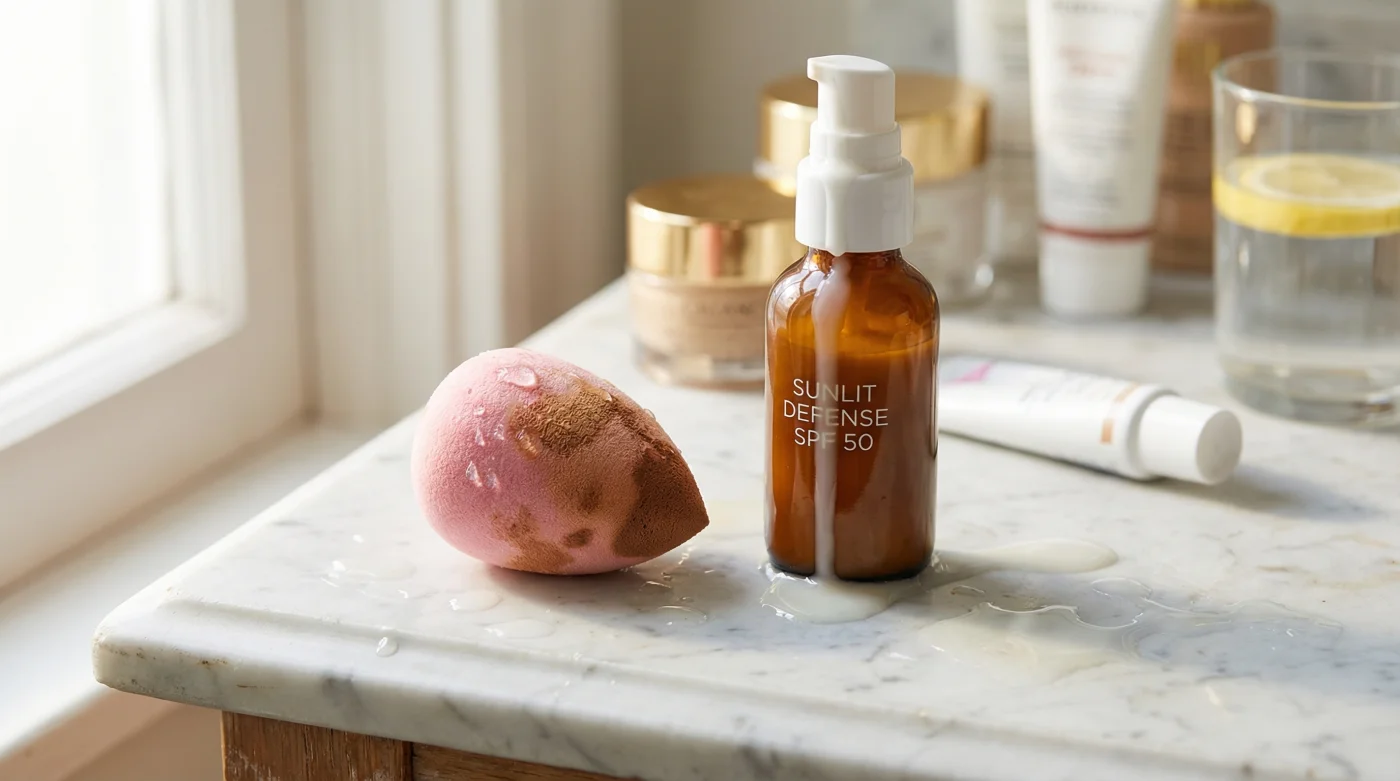
The morning light shifts across your bathroom mirror, catching the faint glint of your freshly applied skincare. The air might still hold the steam from your shower, and the quiet rhythm of the morning feels deeply comforting. You reach for that familiar pink egg, running it under the faucet until it swells to twice its size. You squeeze out the excess moisture, anticipating the cool, satisfying bounce of the foam against your under-eyes.
It feels like a flawless, almost magical smoothing trick. The damp foam diffuses your heavy concealer into a seamless wash of light, blurring away the late hours of the previous night without leaving behind a heavy mask. You have been told for years by countless artists that wet-blending is the absolute secret to avoiding heavy makeup, allowing thick products to meld seamlessly into your skin. We trust this daily rhythm without a single second thought, assuming the water is our greatest ally.
But beneath that even finish, a quiet, completely invisible sabotage is happening right on your face. When you press a damp sponge over your morning skincare, you aren’t just blending pigment to create an illusion of rest. You are physically lifting and erasing the chemical sunscreen you applied just minutes before.
Instead of a solid protective shield across your face, you are inadvertently creating a scattered map of vulnerable skin. Those targeted, heavy taps around the tops of your cheekbones and directly under your eyes—the exact places most prone to severe sun damage and hyperpigmentation—are wiped entirely clean. The water betrays the formula, turning your trusted beauty tool into a microscopic squeegee that leaves you exposed.
The Perspective Shift: Washing the Wet Paint
Think of your sunscreen as an intricate, invisible net that needs critical time to cure on the surface of your face. Chemical filters require a specific, undisturbed period to interact with the top layer of your skin, evaporate their carrying agents, and lock down into a resilient barrier.
When you introduce a wet, highly porous surface to this developing film, you shatter the net before it even forms. Water acts as a powerful solvent for many sunscreen bases, while the aggressive capillary action of the foam physically sucks the protective ingredients up and away from the skin. You are washing wet paint before it ever has a chance to dry, leaving behind dangerous, invisible gaps that invite harsh UV rays directly into your most delicate, thin tissue.
I recently spent a quiet afternoon in a sunlit Brooklyn studio with Maya Lin, a 34-year-old editorial makeup artist known for creating notoriously resilient summer skin on high-profile sets. She showed me a UV camera recording of her applying thick concealer with a damp sponge over a freshly protected face. With every single bounce of the foam, a terrifying black void appeared on the monitor, revealing completely naked skin underneath. ‘We treat sponges like magic wands,’ she noted, watching the screen closely, ‘but they are literally designed to absorb moisture and lift excess product. We are just willfully ignoring what that physical mechanism means for our daily SPF.’
The Adjustments: Rethinking Your Layers
Not all formulas react the exact same way to this mechanical disruption. Adjusting your routine means taking a closer look at the chemistry of your cabinet, and understanding what you wipe away every single morning.
For the Mineral Devotee
If your daily protection relies heavily on zinc oxide or titanium dioxide, you are dealing with physical blockers. These heavy minerals sit entirely on top of the skin like a microscopic coat of armor, reflecting light away from your face. A wet sponge doesn’t just dilute these solid particles; it completely displaces them. You will often notice a subtle piling, flaking, or aggressive separation at the very edges of where you blend, creating a frustrating ridge of white cast that refuses to smooth out.
For the Chemical Purist
Organic filters like avobenzone or homosalate need to firmly bind with the skin’s upper layers to convert UV rays into harmless heat. The moisture from your tool aggressively interrupts this crucial chemical bonding process. The damage is entirely invisible. You won’t see any piling, and your makeup might look flawless, but your protection is severely compromised right where sunspots and fine lines tend to form first.
For the Tinted Minimalist
Perhaps you rely on an SPF-infused base product or tinted moisturizer to do the heavy lifting for your morning routine. Bouncing a heavily soaked applicator over this single, delicate layer shears the coverage out so thinly across the skin that you receive only a tiny fraction of the labeled protection factor, leaving you functionally unprotected.
Mindful Application: The Dry-Blend Protocol
Fixing this dangerous blind spot requires a deliberate shift in how you manipulate your daily tools. You don’t have to give up a soft-focus, beautiful finish, but you absolutely do need to respect the chemistry of your protection.
It starts with simply letting go of the water. A dense synthetic makeup brush or the natural warmth of your own fingertips will move heavy pigment perfectly without disturbing the cured film beneath it. If you truly cannot part with your sponge, it must be completely dry and used with an incredibly light, precise touch.
- Wait a full 10 minutes after your sunscreen application to let the critical film-formers set and securely bind to the skin.
- Warm the concealer on the back of your hand first, relying on your natural body heat rather than tap water to thin the thick consistency.
- Use a dry, densely packed synthetic brush to gently tap the product specifically where you need coverage.
- If using a dry sponge, press gently straight down into the skin; never drag, pull, or swipe across the delicate surface.
Your tactical toolkit relies on patience and the right materials. Keep a dedicated, flat-topped concealer brush clean and ready in your rotation. Your curing time is simply non-negotiable—use those 10 minutes to brush your teeth, style your hair, or simply let the morning settle over a cup of coffee. Heat is your new water, breaking down thick, stubborn pigments without ever compromising your vital protective barrier.
The Bigger Picture: Protecting the Canvas
It can be quite jarring to realize a staple, beloved technique might be working actively against your long-term skin goals. We spend so much energy, time, and money curating the perfect protective layers, only to unknowingly dismantle them for the sake of a fast, smooth finish.
Shifting away from wet-blending does much more than just secure your SPF. It fosters a deeper, more intimate awareness of how your products physically interact, turning a hurried, mindless morning routine into a deliberate, respectful process. You regain total control over your skin’s daily environment. You stop blindly hoping the protection holds up against the sun, and you start knowing it remains intact, silently and securely guarding your skin long after the morning light fades.
“True skin health isn’t just about the expensive formulas you apply, but how carefully you protect them once they are on the skin.”
| Key Point | Detail | Added Value for the Reader |
|---|---|---|
| The Eraser Effect | Damp sponges aggressively lift chemical and physical UV filters off the skin. | Prevents highly targeted, invisible sun damage around sensitive eye areas. |
| Curing Time | SPF requires 10 totally undisturbed minutes to form a resilient film. | Ensures the labeled protection level on the bottle is actually achieved. |
| The Dry Alternative | Natural body heat and dense brushes replace water for blending thick cosmetics. | Maintains a flawless, glowing finish while keeping the invisible armor intact. |
Frequently Asked Questions
Does this mean I have to throw away my sponges?
Not at all. You simply need to use them completely dry and with a light, pressing tapping motion rather than a heavy bounce.What if I use a setting spray to dampen the sponge instead of water?
Setting sprays still contain water and active solvents that disrupt the curing process of your sunscreen. Stick to entirely dry tools.How do I stop my concealer from looking cakey without a wet sponge?
Warm the product on the back of your hand before applying. Your natural body heat thins the formula beautifully without adding disruptive moisture.Is it safe to use a damp sponge if my daily SPF is waterproof?
Water-resistant formulas are designed strictly to withstand sweat and swimming after they fully cure, not the aggressive physical friction of a wet, porous squeegee.Can I reapply SPF over my makeup with a sponge?
Yes, but always use a dry sponge. A dry sponge can safely press an SPF mist or powder over existing makeup without lifting the delicate layers below.