The house is quiet, the evening news has signed off, and you are standing in front of the sink, running through the familiar motions of the night. The bathroom mirror catches the condensation from the hot water you just splashed across your face. You have already massaged in a rich, comforting ceramide cream because the winter air has left your cheeks feeling tight and parched. Now, it is time for the treatment phase.
You reach for the heavy glass dropper bottle, watching the warm yellow bathroom light catch the slightly cloudy liquid inside. It is a highly-rated niacinamide formula, purchased to fade a few stubborn dark spots and calm the redness around your nose. You press the cool fluid gently into the skin, right over the moisturizer you just applied.
The fluid slides across your cheeks, pooling slightly before eventually drying down into a slightly tacky film. You might assume it is soaking in, sinking deep into the cellular structure to do the hard work of repairing your barrier while you sleep. You pat your face lightly, satisfied with the ritual, and turn off the light.
But here is the quiet, expensive truth of the cosmetic industry: that liquid gold is not going anywhere. It is completely stranded on the surface, entirely blocked by the heavy protective blanket you just smoothed over your face a few moments prior.
The Raincoat Effect
Think of your evening moisturizer as a tightly woven wool sweater, interlaced with heavy waxes and lipids. Its primary biological job is occlusion. It is designed to act as a physical barricade, sealing your body’s natural water inside while keeping the harsh, dry air of the outside world far away from your delicate epidermis.
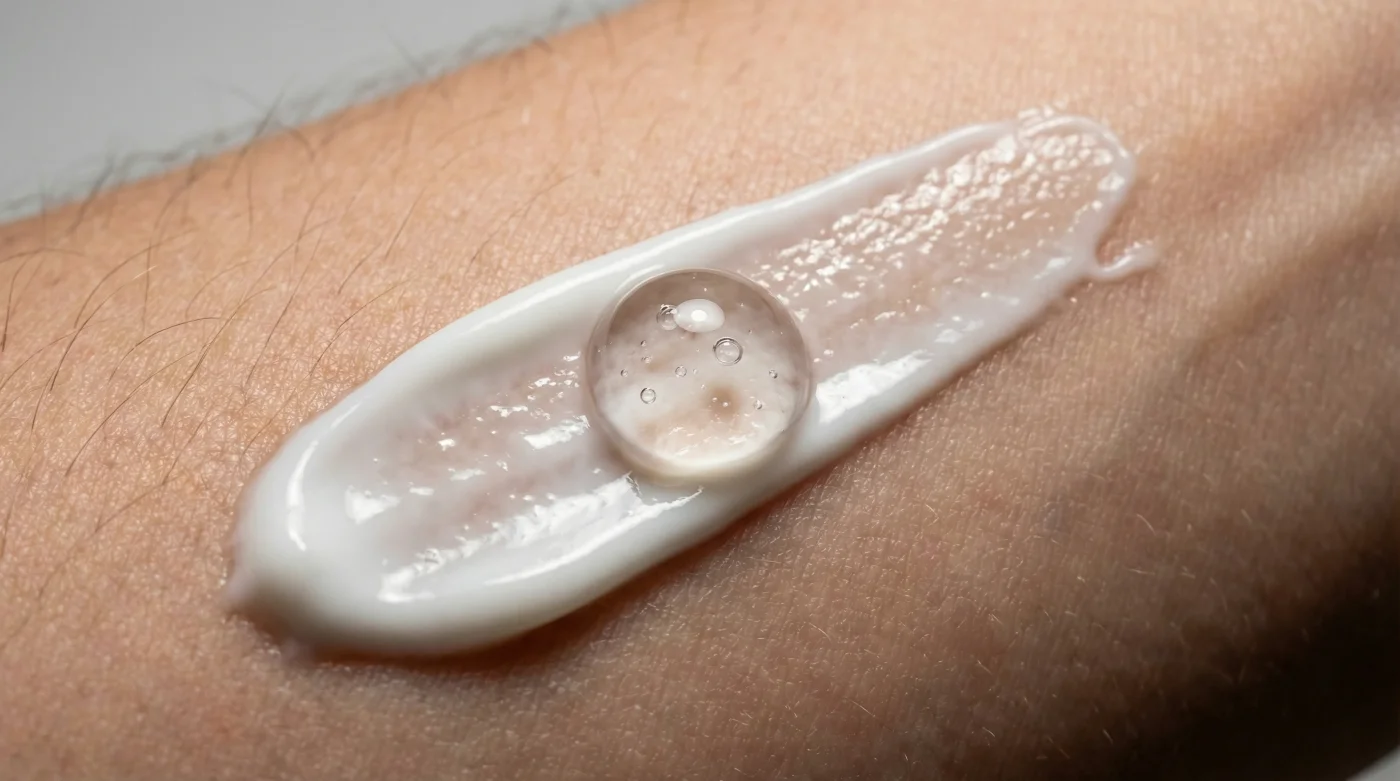
When you layer a water-based treatment like a niacinamide serum directly on top of a lipid-heavy cream, you are essentially pouring water over a raincoat. The serum simply beads up on the barrier. Water and oil inherently repel each other, and without an emulsifying agent to force them together, the thin, watery liquid has absolutely no ability to bridge the gap through the thick wall of fats.
We often treat our sinks like assembly lines, rubbing and patting in whichever order feels the most comforting before bed. But the formulas sitting in your medicine cabinet do not care about your schedule; they only respond to basic chemistry. If you place a lightweight liquid over a dense solid, the liquid stays outside.
The very lipids that make your thick creams so incredibly comforting—shea butter, dimethicone, petrolatum, and heavy ceramides—create an impermeable wall against anything thin. Applying a watery active over a thick paste is like trying to breathe through a heavy down pillow. The active ingredients simply evaporate into the room over the next hour, leaving your wallet lighter and your skin entirely unchanged.
Sarah, a forty-two-year-old cosmetic formulator from Chicago, often watches her private clients bring in bags full of expensive, half-empty dropper bottles, complaining that absolutely none of them work. She pulls out a piece of wax paper and drops a single bead of tap water onto it. “This is your forty-dollar serum sitting on top of your favorite night cream,” she tells them, watching the water refuse to absorb. “You do not need a stronger percentage. You just need to respect the chemistry of the layers.”
She points out that the single biggest mistake in modern bathroom routines is not the quality of the products, but the sequence of the application. The moment you understand the physical weight of what you are holding, the entire process changes.
Navigating Your Cabinet
Not all routines look exactly the same, and the specific jars sitting on your shelf dictate how this fundamental rule applies to your evenings.
For the Purist
You probably rely on two or three reliable items and prefer to keep things incredibly simple. If you use a basic cleanser, your watery niacinamide treatment, and a daily lotion, the rule is rigid. Always let the thin fluid absorb into bare skin, dry down slightly, and then seal it permanently for the night with the lotion.
For the Barrier-Obsessed
- Collagen powder mixed into morning coffee destroys the amino acids.
- Epsom salt baths strip away crucial skin ceramides almost instantly.
- Castor oil eyebrow treatments suffocate follicles causing permanent hair thinning.
- Niacinamide serums applied over heavy creams render expensive routines useless.
- Sydney Sweeney skincare routine highlights an ingredient banned in Europe.
For the Multi-Serum Layerer
You might have a hydrating liquid toner, a vitamin C derivative, and your targeted niacinamide. Here, the thinnest liquid always wins. Move meticulously from the consistency of tap water up to the consistency of warm honey, saving the true, opaque cream for the grand finale.
Mindful Application
Correcting your routine does not require purchasing a single new product or throwing away what you already own. It simply asks for a few extra moments of deliberate intention at the bathroom sink.
Instead of rushing through the motions to get to bed faster, feel the weight of the liquids between your fingers before they ever touch your face. A simple tactical shift is all it takes:
- Cleanse and reset: Wash with lukewarm water, pressing a clean towel against your face until it is barely damp, not dripping.
- The water phase: Dispense three drops of the niacinamide serum. Press it gently into your bare cheeks, forehead, and chin. Let the warmth of your hands guide it in.
- The breathing room: Pause for roughly sixty seconds. The skin should feel slightly tacky to the touch, and no longer wet.
- The lipid seal: Warm a dime-sized amount of your heavy cream between your palms, melting it slightly, then press it firmly over the serum.
This single minute of patience fundamentally alters the chemical interaction occurring on your face. You are no longer wasting high-quality ingredients on the pillowcase.
The active components sink immediately into the skin’s upper layers, and the cream places a protective lid over them, forcing the hydration down and keeping the treatment exactly where it belongs until morning.
The Bigger Picture
There is a specific kind of quiet frustration in spending hard-earned money on a small glass bottle of promise, only to see absolutely no change in the mirror month after weary month.
We often blame the brand for selling us snake oil, or we blame our own stubborn biology, assuming we are the exception to the rule. We assume our skin is just too damaged, too old, or too sensitive to see the glow everyone else talks about.
But understanding the simple mechanics of water and oil removes that heavy frustration. It gives you back complete control over your routine, turning a blind, hopeful ritual into a deliberate, effective practice. You are no longer guessing in the dark.
You are constructing a microscopic environment where your skin can actually rest, repair, and properly digest exactly what you feed it. And that kind of mastery is worth far more than the price of the serum itself.
“Skincare is not magic; it is just applied chemistry. Respect the weight of the water, and the skin will follow.”
| Key Point | Detail | Added Value for the Reader |
|---|---|---|
| Application Order | Always apply thinnest (water-based) to thickest (oil-based). | Ensures active ingredients actually reach the skin matrix. |
| Wait Times | Pause 60 seconds after water-based serums before moisturizing. | Prevents product pilling and allows initial absorption. |
| Lipid Barriers | Heavy creams physically block water-based products from entering. | Saves money by not wasting expensive serums on the surface. |
Frequently Asked Questions
Do I have to wait between every single layer?
No, only between fundamentally different textures. Give thin serums a moment to dry down before applying heavy creams to prevent them from wiping off.What if my serum feels slightly oily?
If it feels like an oil, it contains lipids. Apply it after your purely water-based serums, but before your final, heaviest moisturizing cream.Can I mix my serum directly into my cream in my hand?
While convenient, this dilutes the active ingredients and wraps them in the cream’s protective waxes, severely limiting how much actually penetrates the skin.How do I know if my moisturizer is a heavy barrier?
Check the ingredients. If shea butter, dimethicone, petrolatum, or waxes are near the top of the list, it acts as a strong physical barrier.Will applying watery serums right after washing cause irritation?
Niacinamide is generally very gentle. Applying it to damp, bare skin actually helps it absorb better, utilizing the moisture already present on your face.