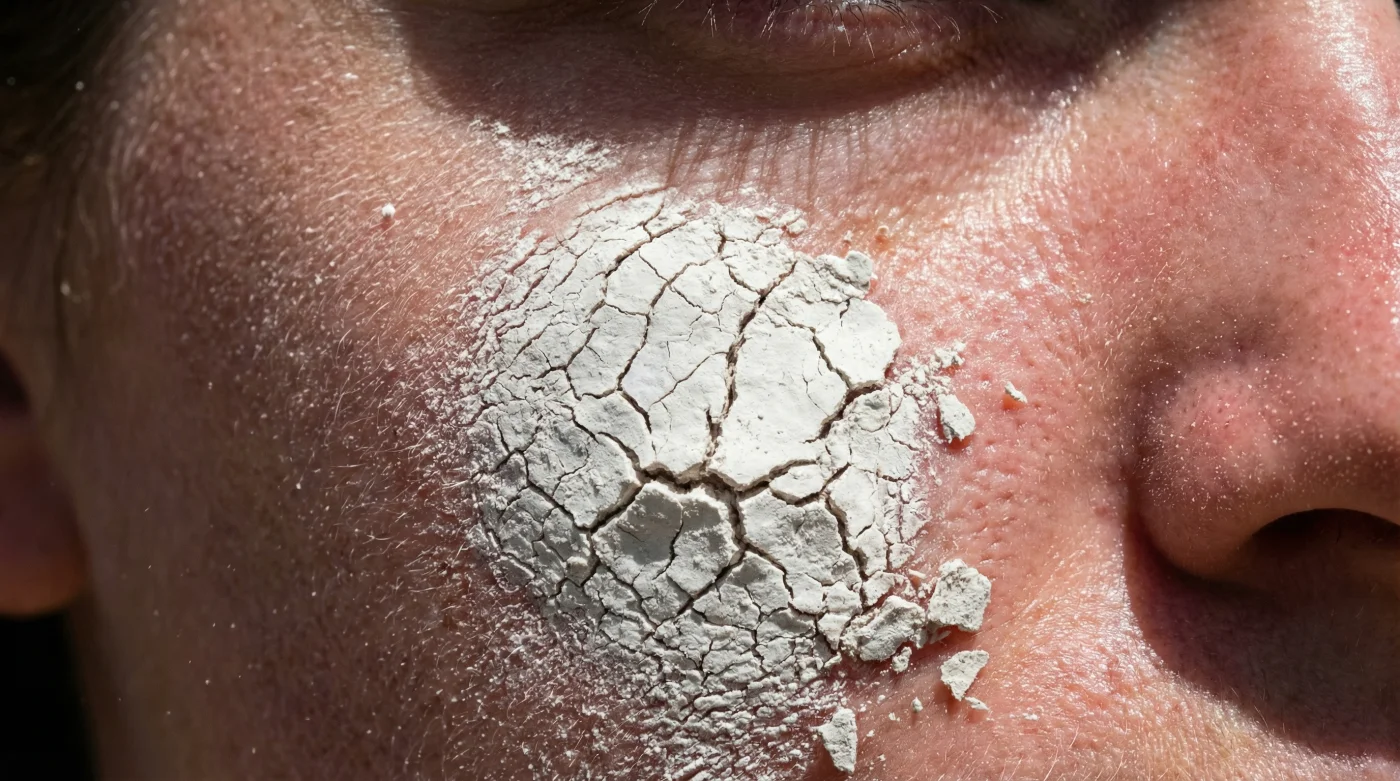
The late July sun hits the asphalt, bouncing a brutal glare right into your eyes. You reach into your bag, feeling for the familiar, satisfying click of a plastic brush cap. You swirl the bristles, watching a faint cloud of tinted dust settle into the humid summer air before applying it to your skin.
Sweeping that soft mineral powder across your forehead feels incredibly reassuring. It mattifies the midday sweat instantly, pulling away the heavy grease left behind by your morning skincare. You catch your reflection in a shop window, looking flawlessly matte, completely convinced you just armored your face against the afternoon radiation.
But under a specialized UV camera, that invisible armor tells a wildly different story. Instead of a solid wall of zinc reflecting the light, your skin looks like a patchy, porous sieve. The comforting matte finish is masking a massive vulnerability, leaving your cheeks and nose directly exposed to the very damage you thought you were preventing.
The reality of powder sunscreens is quietly shifting in dermatology circles. The product itself is not broken, but the way we trust it as a standalone shield is a mathematically flawed defense. It is time to look at what that powder actually does when it meets the skin.
The Illusion of the Invisible Shield
Let us talk about the cold mechanics of sun protection. When a manufacturer tests a powder for its SPF rating in a laboratory setting, they do not dust it lightly over a moving, sweating human face. They apply a dense, heavy layer to a stationary glass plate, packing the minerals down until no light can pass through.
To replicate that laboratory SPF 30 on your own face, you would need to apply fourteen times the normal amount of product. Imagine grinding the brush into your skin for three solid minutes until you look like you fell face-first into a bag of powdered sugar. A quick dusting provides only a fraction of the promised protection.
Relying on a fast swirl of powder as your primary defense is like trying to paint a house with a dry sponge. However, recognizing this weakness completely changes how you use it. Instead of a failing primary shield, the powder becomes an elite secondary defender, stepping in to absorb oils while holding your morning liquid application in place.
Clara Aris, a 42-year-old cosmetic chemist based in Austin, Texas, spent months studying UV imagery of popular mineral powders. She noticed a disturbing pattern among her clients who spent weekends boating on Lady Bird Lake. They were coming in with aggressive sunspots despite reapplying their powder religiously every two hours. Clara realized the soft bristles were merely scattering the titanium dioxide, not bonding it to the epidermis. She started advising her clients to treat powder SPF exactly like a makeup setting powder—a finishing touch meant to lock down the heavy lifting already done by a liquid base.
For the Bare-Faced Purist
If you skip foundation entirely, powder SPF should never be your first line of defense. Start your morning with a robust liquid mineral or chemical lotion, letting it sink in and set for a full fifteen minutes before you walk out the door. The liquid forms an unbroken film across your pores.
You should strictly use your powder brush to knock back the shine at noon. Think of it as an oil-control mechanism that happens to have a bonus layer of zinc, rather than your main source of safety.
For the Heavy Foundation Wearer
You likely loathe the idea of rubbing a liquid lotion over a fully baked face of makeup. Smearing a cream at 2 PM will destroy your concealer and leave your complexion streaky. Here, the powder is your only viable midday option.
To make it actually count, do not just casually dust it. You must press the bristles firmly against your skin in tight, rolling motions, depositing the crushed minerals directly into the grip of your foundation. The makeup acts as an adhesive, catching the zinc and holding it tight.
For the Sweaty Commuter
By the time you walk three blocks in 90-degree heat, your face is inevitably melting. Powder will immediately streak, cake, and clump if applied directly to active sweat. The moisture prevents the minerals from spreading evenly, creating literal gaps in your protection.
- US Customs bans specific Shein clothing shipments over material violations.
- Sephora restricts anti-aging purchases for preteens under new guidelines.
- Coconut oil masks create brittle hair shafts for blondes.
- Dry cleaning cashmere sweaters guarantees permanent fiber damage quickly.
- UV gel manicures weaken nail beds through this removal mistake.
The Tactical Reapplication Method
Transforming a dusting of powder into actual protection requires deliberate mechanics. It is not about speed or convenience. It is about friction, pressure, and density.
You need to force the minerals to bind with the natural oils or the liquid sunscreen already sitting on your face. Try viewing your brush as a stamping tool rather than a sweeping broom.
- Prime the bristles: Tap the base of the brush firmly against your wrist until you physically see a cloud of powder rising to the top of the hairs.
- Use the stamping method: Do not sweep or drag the brush. Press the brush head flat against your skin, lift it, move half an inch, and press again.
- Double the pass: Go over your entire face twice. The first layer absorbs excess oil; the second layer actually builds the protective mineral film.
- Target the high planes: Focus aggressively on your forehead, the bridge of your nose, and the tops of your cheeks, as these areas catch the most direct radiation.
Peace of Mind in the Glare
Sun protection is often sold to us as a list of rigid, clinical rules, but true skin health is really about understanding how your tools operate in the real world. A brush full of powder is a wonderful thing, provided you respect its limitations.
When you stop expecting a delicate mineral dust to act like a heavy zinc shield, the anxiety of getting sunburned under your makeup slowly fades away. You replace false confidence with actual, mechanical strategy.
You begin to see your midday routine not as a chore, but as a deliberate ritual of self-care. Stepping out into the bright afternoon glare no longer feels like a gamble. You are walking out with a quiet confidence, knowing your invisible layers are working precisely as they should.
The true power of any skincare tool lies not in what the label promises, but in how beautifully you adapt it to the reality of your own skin.
| Key Point | Detail | Added Value for the Reader |
|---|---|---|
| The Math of SPF | You need 14 times the normal application amount to achieve the label rating with powder. | Prevents you from relying on a false sense of security during peak UV hours. |
| The Liquid Base | Powder must act as a secondary layer over a strong liquid chemical or mineral lotion. | Ensures your skin has an unbroken barrier of defense against photoaging. |
| The Stamping Technique | Pressing the brush into the skin rather than sweeping it prevents microscopic gaps. | Maximizes the actual UV-blocking potential of your expensive mineral powders. |
Frequently Asked Questions
Can I use powder sunscreen on my scalp and parting?
Yes, powder is actually brilliant for the hairline and scalp. It absorbs hair oil while providing a secondary layer of zinc without making your roots look incredibly greasy.
Does a higher SPF rating on a powder mean I can use less of it?
No. The testing parameters remain the same. Even with an SPF 50 powder, a light dusting will only yield a fraction of that number in real-world conditions.
How do I clean my powder sunscreen brush without ruining it?
Wipe the bristles weekly with a tissue lightly sprayed with an alcohol-based makeup brush cleaner. Never soak the brush head, or water will clog the powder chamber below.
Will mineral powder cause a white cast on darker skin tones?
Many standard zinc powders will leave an ashy finish. Look for finely milled powders with iron oxide tints, which blend seamlessly into deeper complexions while blocking visible blue light.
Can powder sunscreen expire if it just sits in my bag?
The minerals themselves do not degrade, but the brush harbors bacteria and the powder can clump from humidity. Always replace your powder brush annually to ensure sanitary, even application.