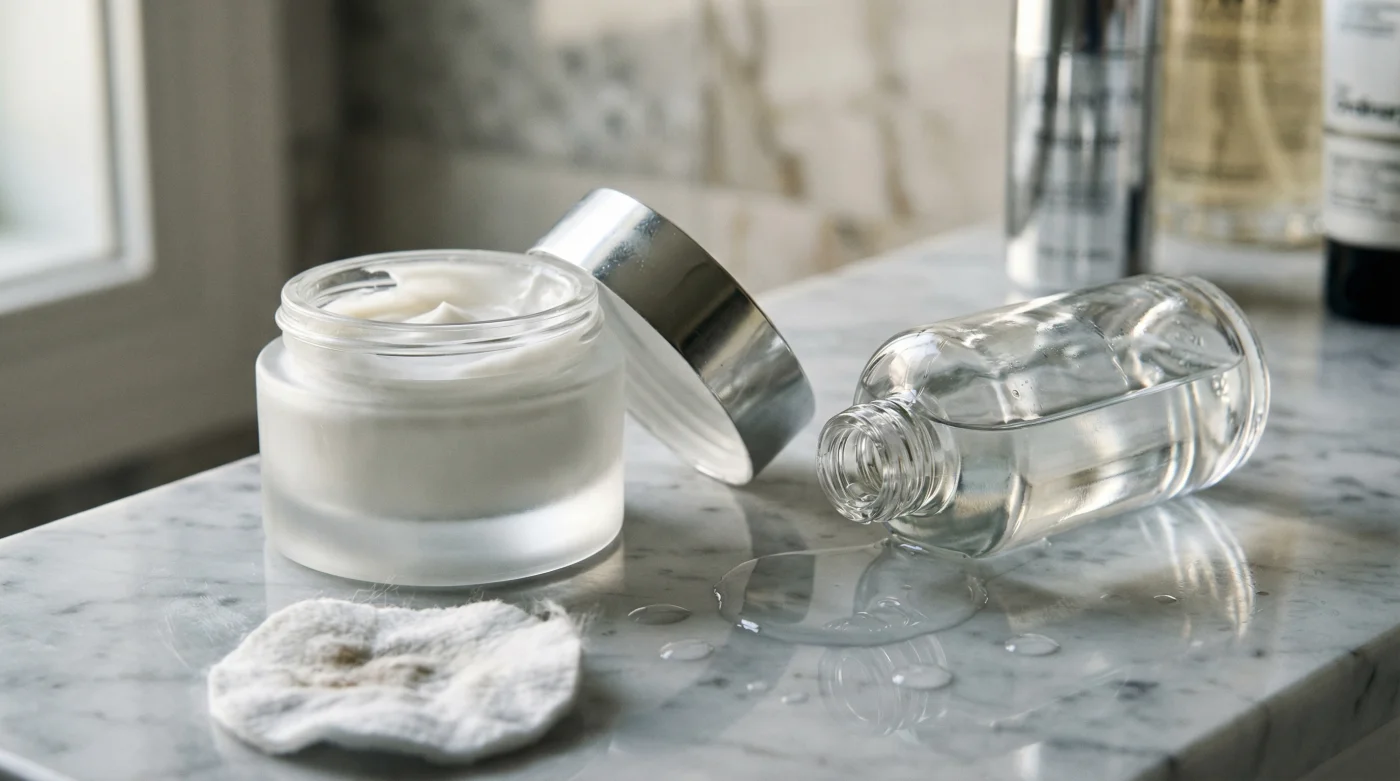
The ambient hum of the bathroom fan. The cool, weighty feel of frosted glass jars on the vanity. You uncap the glycolic acid, relishing the slight, familiar sting that promises cellular turnover and a brighter morning. Then comes the luxury—a rich, buttery peptide cream smoothed over the top to rebuild, plump, and firm. You wipe your hands on a towel, walking away confident you just fed your face a perfect, powerful breakfast of anti-aging science.
But beneath the surface, a quiet, invisible war is raging. Your expensive ingredients are fighting, and unfortunately, nobody wins. The powerful acids you applied to dissolve dead skin are now systematically dismantling the fragile amino acid structures of your peptide cream, turning a ninety-dollar investment into a completely inert paste.
We are conditioned to believe that more is always better. If one active compound smooths rough texture and another rebuilds lost collagen, stacking them together should logically create a flawless result. This line of reasoning drives us to pile on serums and thick creams, hoping the sheer volume of application will somehow outsmart time and biology.
The reality of chemical formulation is far less forgiving. Peptides are incredibly fragile chains, requiring highly specific, stable environments to signal your cells to produce collagen. When you drop them directly into a highly acidic environment, they break apart immediately, leaving you with nothing but a compromised barrier and an empty wallet.
The Perspective Shift: The Anatomy of a Chemical Clash
Think of peptides as tiny, highly trained messengers holding blueprints for a house. Their only job is to walk into the busy construction site of your skin and tell the workers exactly where to lay down new collagen and elastin fibers. When they arrive in a calm environment, the work gets done beautifully.
Now imagine releasing those delicate messengers into a torrential downpour of vinegar. Glycolic acid drastically lowers pH, creating an acidic environment that is deeply hostile to delicate protein structures. The messengers never make it to the construction site; their blueprints literally dissolve in the rain. What you thought was a powerhouse anti-aging protocol is actually a chemical demolition zone.
The profound realization here is that the mundane detail of application order is actually your greatest advantage. You do not need stronger products, harsher treatments, or more complicated evening routines. You simply need to respect the chemistry of the formulas you already own.
Giving your specific ingredients their own space creates profound, noticeable results without spending an extra dime. The limitation of not mixing them becomes a lesson in skin fasting—allowing one active compound to perform brilliantly before introducing another variable to the face.
The Lab View: Dr. Thorne and the Broken Chains
Dr. Aris Thorne, a 54-year-old cosmetic formulator based in a sunlit New Jersey lab, spends his days watching compounds interact under a powerful microscope. He often likens the modern consumer skincare routine to an over-seasoned pot of soup—too many cooks throwing in potent spices until the whole thing tastes like bitter mud.
“I watch consumers layer a ten-percent glycolic acid straight under a delicate copper peptide serum,” Dr. Thorne explains, adjusting the lens on his equipment with a sigh. “The peptides snap almost instantly.” He notes that people often complain their expensive peptide creams do absolutely nothing, completely unaware they are actively neutralizing the formula every single night with their exfoliating toners.
Tailored Protocols: Sequencing Your Active Ingredients
Adjusting your routine does not mean sacrificing the benefits of either ingredient. It simply requires you to become a better air traffic controller for your vanity, landing the right products at the right time so they do not crash into one another.
For the Exfoliation Devotee: If you rely heavily on glycolic acid for that glass-like polish, keep it firmly in your evening routine. Keep acid in the evening, as glycolic acid naturally increases photosensitivity anyway. Follow it solely with a basic, ceramide-rich moisturizer that contains zero peptides. Let the acid work uninterrupted in the dark while you sleep.
For the Barrier Builder: If your primary goal is thickening thin skin and reducing fine lines, peptides need to be the undisputed star of the show. Move your expensive peptide creams and serums exclusively to your morning routine.
By shifting your schedule, you apply them to clean skin, allowing them to penetrate a totally neutral pH environment. Top them with a reliable sunscreen and walk out the door knowing those delicate amino chains are perfectly intact and working hard.
For the Minimalist: Skin cycling is your absolute easiest path forward. Designate Mondays and Thursdays as your dedicated acid nights to clear away dead surface cells. Use your restorative peptide creams on the alternating recovery nights to feed the freshly revealed skin.
Mindful Application: The Tactical Toolkit
Mastering your application is about slowing down. Timing is your greatest tool. It is the difference between rushing frantically out the door and sitting down to properly tie your shoes before a long run.
If you absolutely must use both products in the same time frame—perhaps you only have time for an extensive routine at night—you need a highly tactical approach to manage the shifting pH levels on your face.
- The 30-Minute Rule: Apply your glycolic acid first. Set a kitchen timer for thirty minutes. This gives your face enough time to naturally neutralize the acid and return to its biological baseline pH.
- The Damp Rinse: After the thirty-minute acid window closes, lightly mist your face with plain tap water or a basic hydrating toner. This washes away residual acidity before you rub in the peptide cream.
- Temperature Matters: Keep your peptide creams stored in a cool, dark drawer. Ambient heat can further destabilize amino chains, making them even more susceptible to sudden acid breakdown.
- The Texture Hierarchy: Always apply thinnest to thickest, but only after the pH has neutralized completely. A watery peptide serum will still fail entirely if applied immediately over a thick, acidic cream.
The Bigger Picture: Finding Peace in Precision
There is a specific kind of mental exhaustion that comes from trying to do everything right and still feeling like you are falling behind. We cram our medicine cabinets with heavy glass bottles, chasing the vague promise of preservation, only to feel completely overwhelmed by daily maintenance.
Understanding exactly how these ingredients interact lifts the burden of consumption. When you realize that strategic separation makes your current products twice as effective, the frantic, persistent urge to buy the next new serum completely fades away.
You stop relying on blind hope and start relying on grounded, quiet chemistry. Your morning and evening bathroom rituals become quiet moments of intention rather than rushed, panicked daily chemistry experiments.
You finally step away from the mirror knowing you did enough, feeling the subtle, undeniable relief of working with your biology instead of fighting blindly against it.
“Good skincare isn’t about how much pain or peeling you can tolerate; it’s about giving brilliant ingredients the exact environment they need to thrive.”
| Key Point | Detail | Added Value for the Reader |
|---|---|---|
| The pH Clash | Glycolic acid lowers pH, which dismantles peptide amino chains. | Saves money by preventing the neutralization of expensive products. |
| Morning vs. Evening | Peptides thrive in neutral daytime pH; acids work best at night. | Maximizes the distinct benefits of both collagen signaling and exfoliation. |
| The 30-Minute Rule | Waiting allows the skin to return to its natural baseline pH. | Provides a safe workaround for those who prefer doing everything in one routine. |
Frequently Asked Questions
Can I use Vitamin C with my peptide cream?
Like glycolic acid, L-ascorbic acid requires a very low, acidic pH to remain stable. It is best to separate them completely, using your Vitamin C in the morning and peptides at night, or vice versa.What happens if I have already mixed them for months?
You have not caused any permanent damage to your face. You simply missed out on the benefits of the peptide cream, as the acid neutralized it before it could signal collagen production.Are there any acids that play nicely with peptides?
Hyaluronic acid is perfectly fine. Despite the word ‘acid’ in its name, hyaluronic acid is actually a humectant sugar with a neutral pH, making it an excellent companion for hydrating your peptides.Do I need to wash my face between applications?
If you wait thirty minutes, your skin will self-neutralize. However, a light splash of water or a hydrating, alcohol-free toner can speed up the process and guarantee a neutral base.Does this rule apply to all types of peptides?
Copper peptides are notoriously the most fragile and will break immediately. While some carrier peptides are slightly hardier, the general rule of separating them from low-pH exfoliating acids remains the safest bet for your investment.