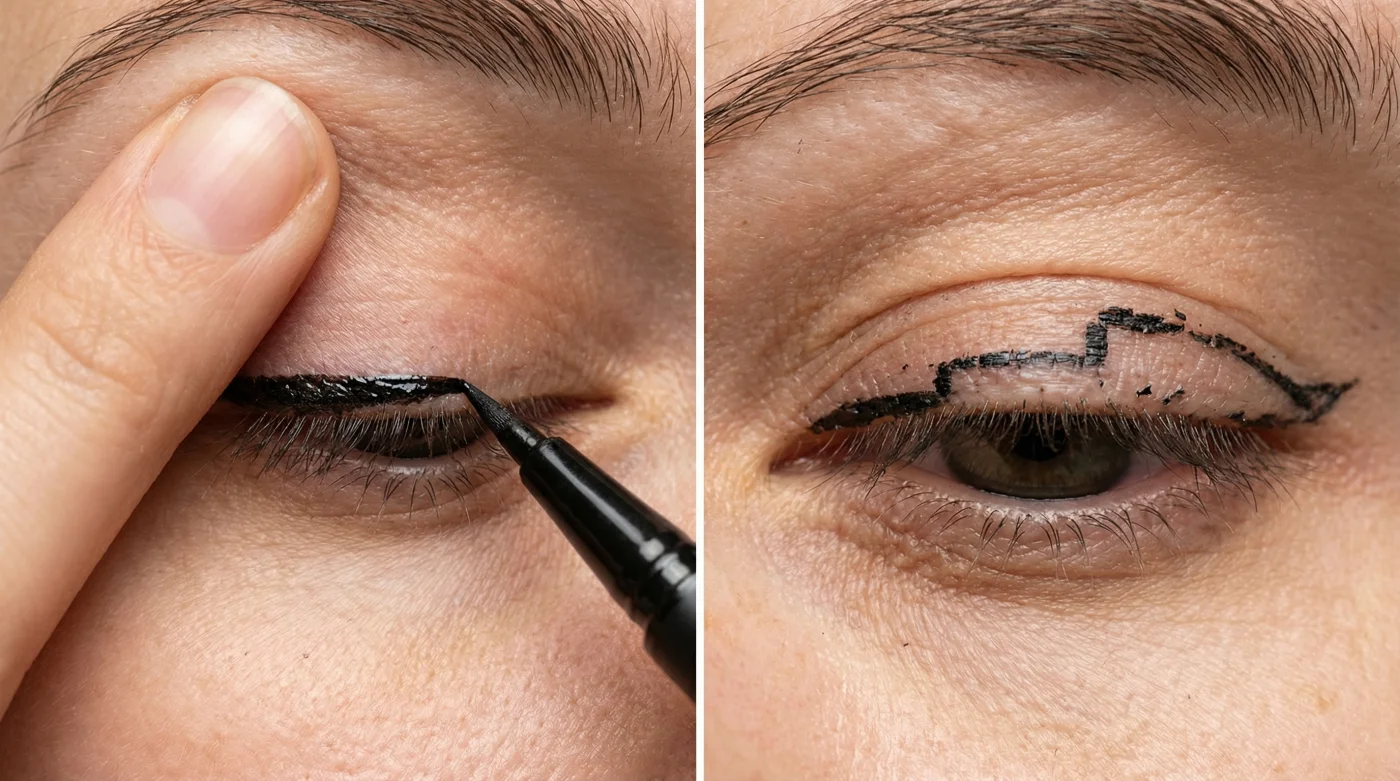
The bathroom is quiet, save for the faint hum of the exhaust fan. You uncap the liquid eyeliner pen, hearing that satisfying plastic snap. You lean in close until your breath fogs the bottom edge of the mirror. Your hand is steady, and you are ready to frame your eyes for the day ahead.
Instinct takes over. Your index finger finds the outer corner of your eye, pulling the delicate skin taut toward your temple. The surface becomes perfectly smooth, a blank slate ready for the ink. You draw a sharp, flawless line that feels like a tiny victory to start the morning.
Then, you let go. The skin snaps back, folding over itself as the tension releases. The razor-sharp wing you just crafted suddenly crumbles into a jagged, uneven hook. The frustration is visceral. You grab a cotton swab and micellar water, silently cursing your own hands. But the failure is not in your wrist; it is in the tension.
The Illusion of the Taut Canvas
Think of your eyelid like a piece of draped silk. If you stretch the fabric over an embroidery hoop, paint a straight geometric line across it, and then remove the tension, the line will violently distort as the material naturally falls back into its resting folds.
Stretching your lid forces your eye into an artificial state. It erases the natural topography of your face, hiding the micro-folds, hoods, and creases that make up your actual anatomy. When you apply wet pigment to this false canvas, you guarantee an uneven resting placement the moment your facial muscles relax.
The secret to an effortless wing is remarkably simple, yet completely counterintuitive to everything we were taught in front of middle school vanity mirrors. You have to look at yourself exactly as the world sees you. Applying on a relaxed eye maps your true facial contour, turning what you thought was an obstacle—the crease of your eyelid—into a structural guidepost.
Elena Vance, a 41-year-old editorial makeup artist based in Chicago, learned this the hard way during a high-stakes bridal shoot. She spent twenty minutes pulling and painting a model’s eyes to geometric perfection, only to watch the wings droop the second the woman smiled warmly. Elena stopped touching her clients’ temples entirely that afternoon. Now, she makes them stare dead-pan into a hand mirror, chin level, eyes completely open. She draws the wing directly across the natural folds, connecting the gaps only after the shape is set. Up close, with the eye closed, it looks like a staggered staircase. But from a conversational distance, the illusion is completely unbreakable.
Adapting to Your Anatomical Architecture
Every eye shape demands a unique approach to liquid ink. Treating all eyes as identical smooth surfaces is precisely why so many tutorials fail to translate to your specific reflection. You must establish a dialogue with your natural architecture, rather than imposing a one-size-fits-all stamp onto your skin.
For the Hooded Lid
The fold is your dominant feature, and it is beautifully expressive. Staring straight ahead into your mirror, you must sketch the wing directly over the hood while your eye is open. When you eventually close your eye, the line will look like a disjointed step or a batwing. Leave it exactly like that. When your eye is open, it reads as a continuous, sweeping stroke that defies gravity.
For the Mature Contour
As our skin loses elasticity over the years, pulling it becomes a losing game of tug-of-war. The trick here is to use a gentle stamping motion rather than dragging the felt tip across the lid. The soft skin will accept the liquid ink seamlessly without skipping or catching on the micro-texture.
For the Deep-Set Eye
Your brow bone naturally casts a shadow over your outer corner, which can make heavy eyeliner look instantly heavy. Keep the line incredibly thin at the inner corner, only thickening it as you pass the outer third of the iris. Look straight ahead and use the angle of your lower lash line to dictate the upward flick, ensuring it clears the heavy crease of your upper lid.
The Relaxed Gaze Method
Rewiring your muscle memory takes a little patience. The goal is to keep your facial muscles completely passive, almost as if you are daydreaming at a bus stop. You want the face to sit exactly where it sits for the majority of your waking hours. Breathe deeply through the stillness, dropping your shoulders away from your ears before the pen even touches your skin.
- Place a mirror flat on a table and look down into it, keeping your chin neutral and your eyes half-open.
- Keep your non-dominant hand entirely away from the side of your face; resist the urge to anchor your pinky on your cheekbone.
- Mark a single dot at the outer corner where you want the wing to terminate.
- Draw a straight line from that dot back to your lash line, letting the pen glide lightly over any creases without pressing down into the skin.
- Fill in the blank spaces only after the skeletal frame of the wing is established and you have verified the shape with an open eye.
Building your application station correctly is half the battle. This is your Tactical Toolkit: A firm felt-tip pen is superior here, as brush tips are often too flexible for beginners navigating folds. You need a magnified hand mirror held just below eye level to maintain that relaxed, half-mast gaze. Finally, keep pointed cotton swabs dipped in an oil-free makeup remover nearby for cleaning the outer lower edge, creating a razor-sharp finish without touching the top line.
Honoring Your True Reflection
There is a quiet liberation in putting down your hands and letting your face rest naturally. For years, we have been conditioned to stretch, pull, and manipulate our features to fit a predetermined, mathematically straight template that simply does not exist in nature. By working with your eye exactly as it is, you stop fighting your own anatomy.
The daily ritual of applying your liquid eyeliner stops being a source of morning anxiety and becomes a moment of acceptance. You are no longer forcing a straight line onto a curved, beautifully complex surface. You are mapping the unique landscape of your own eyes, creating an accent that lives harmoniously with your micro-expressions, your smiles, and your resting face. When you finally step back from the glass and lower the pen, the result isn’t just symmetrically sound; it is authentically, perfectly yours.
Your face is not a canvas to be stretched; it is a landscape to be mapped. Let the ink follow the hills and valleys naturally.
| Key Point | Detail | Added Value for the Reader |
|---|---|---|
| The Taut Canvas Myth | Pulling the skin alters the natural resting placement of the eyelid. | Prevents the dreaded jagged hook when the eye relaxes. |
| The Open-Eye Technique | Applying liner while looking straight ahead with resting muscles. | Ensures the wing flatters your face during normal interactions. |
| The Batwing Method | Drawing across the hood, leaving a step-shape when closed. | Allows hooded eyes to wear thick wings without smudging. |
Frequently Asked Questions
Why does my eyeliner smudge to my upper lid?
Applying on a stretched lid pushes wet ink into creases that touch when you blink. Relaxed application avoids the danger zones.Do I need a special type of liquid liner for this?
A firm felt-tip pen offers better control over folds than a hyper-flexible brush tip, which can splay over textured skin.How do I fix a mistake without pulling my eye?
Use a pointed precision cotton swab with a tiny drop of micellar water to carve the bottom edge clean.What if my hands shake when I don’t anchor the skin?
Rest your elbow on a table and plant your pinky finger on your chin or jawline, leaving the delicate eye area completely untouched.Does this work for pencil liner too?
Yes, mapping the resting contour works for all mediums, though pencils require a gentler touch so they do not drag the skin naturally.