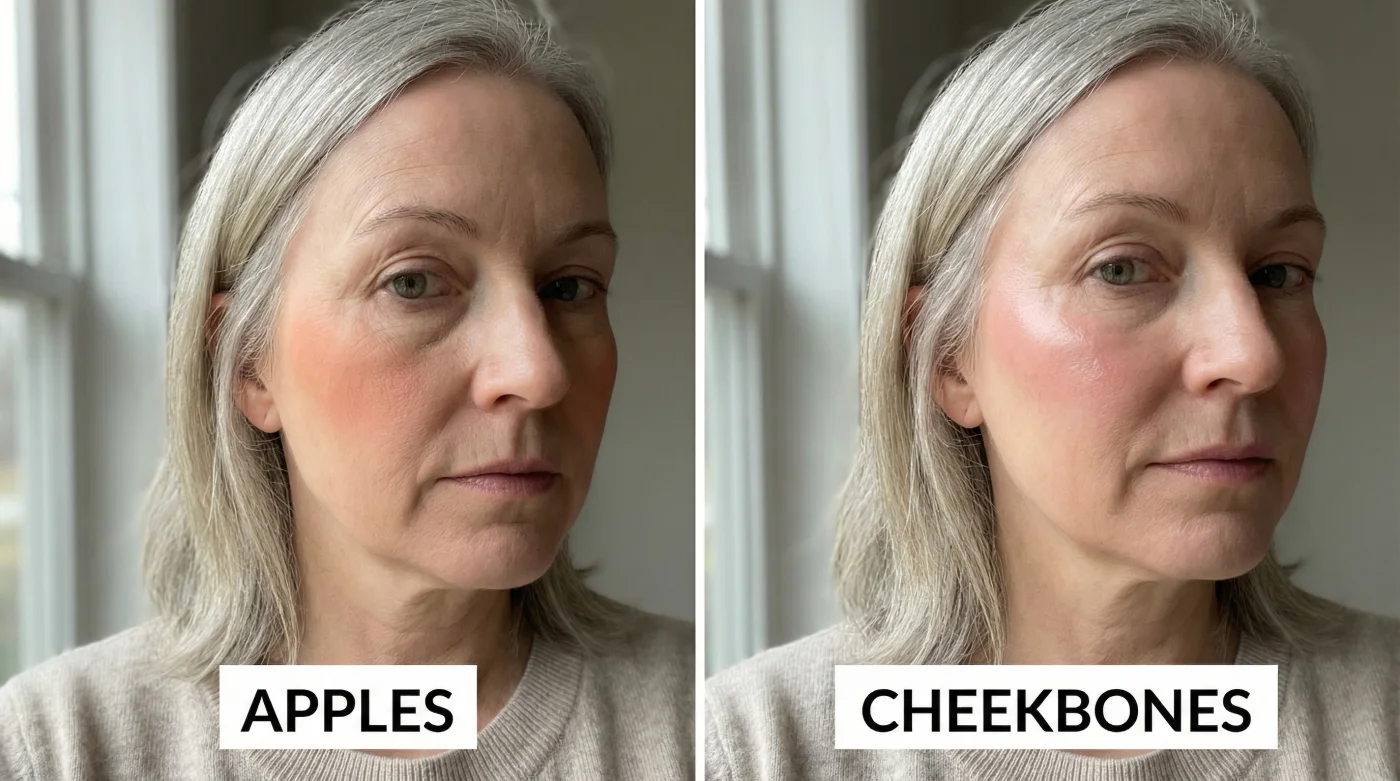
The morning bathroom light catches the soft dust floating off your favorite fluffy brush. You dip into that familiar pressed compact, smile to find the apples of your cheeks, and sweep the color back toward your temples. It is muscle memory, a ritual you have practiced since your twenties.
But lately, that familiar sweep of color feels different. Instead of a fresh morning flush, the pigment seems to gather in subtle shadows, pulling your features downward rather than offering that buoyant, rested look you intended.
The truth is, the architecture of your face shifts quietly over the years. What once caught the light effortlessly now interacts with gravity and natural volume loss in entirely new ways. That trusty powder blush, especially when placed right on the traditional cheekbone or the fleshy apple, is playing a visual trick on you.
It is not your technique failing; it is the formula and the geography. You are painting a vintage map on a beautifully evolving landscape. By simply changing medium and latitude, you can redefine the entire structure of your face before your morning coffee cools.
The Suspension Bridge Effect
Think of your facial structure like a suspension bridge. In our earlier years, the cables are pulled taut, and weight is distributed evenly across the apples of the cheeks. Placing a matte powder right in the center worked because the canvas was inherently firm and static.
As we mature, the tension naturally relaxes. The skin softens, and the underlying volume shifts subtly southward. When you apply a flat, powdery pigment directly onto the cheekbone or the apple, you are anchoring visual weight exactly where gravity is already doing its work. It reads as heavy, tired, and structurally draining.
The shift happens when you trade dust for dew, and lower-middle placement for the upper atmosphere. Cream formulas do not just sit on top of the skin; they melt into it, mimicking the natural lipids your skin produces and restoring a supple finish that powders aggressively absorb.
But the real magic lies in defying the old rulebook completely. By intentionally bypassing the traditional apple and moving your pigment a fraction of an inch higher, you create an optical illusion that visually lifts the entire jawline.
Consider Eleanor, a fifty-four-year-old session makeup artist who spent decades painting faces for high-fashion editorials. For years, she religiously taught models to smile and dust powder right on the fleshy center of the cheek. But when she hit her fifties, she noticed her own reflection looked unexpectedly drawn. One morning, running late and out of her usual powder, she tapped a sheer berry lipstick onto the high points of her cheekbones—almost at the outer corner of her eye—and blended it upward. The result was an instant, non-surgical lift. She realized that by shifting the focal point away from the fleshy center and using a hydrating texture, she was forcing the viewer’s eye up, elongating the lower face and reviving the skin’s natural tension.
Finding Your Structural Harmony
Not all mature skin behaves the exact same way. The way you adapt this higher, cream-based technique depends largely on how your unique features are softening over time.
For those experiencing a general loss of facial volume—where the cheeks feel slightly hollower—you want to focus on creating an illusion of plumpness without dragging the eye down. Here, you should tap your cream pigment just above the hollow, letting the glossy finish catch the light and simulate fullness.
If your volume is shifting downward into the jawline, your strategy changes. You need to pull the visual weight aggressively upward to counterbalance the softness below.
Focus your application almost entirely on the upper, outer quadrant of the cheekbone. Think of blending the color into your temple hairline, treating the blush almost like a soft, vibrant contour that works against gravity.
For skin that has become highly textured or deeply lined around the eyes, keep the cream slightly lower than the crow’s feet but still higher than the traditional apple. Choose a formula with no shimmer—only a balmy sheen—so it does not settle into expression lines and create unnecessary visual clutter.
The Tactile Lift
Transforming your routine requires a shift from passive brushing to active, tactile pressing. Put the brushes away for a moment and rely on the warmth of your own hands.
Start with beautifully prepped skin. A cream blush needs a hydrated base to melt properly, otherwise it will grip dry patches and ruin the seamless illusion you are trying to build.
- Warm a tiny amount of cream blush on the back of your non-dominant hand until it feels like body-temperature butter.
- Using your middle and ring fingers, pick up the softened pigment.
- Locate the outer corner of your eye and drop down half an inch. This is your new starting point.
- Press the color into the skin using a gentle stamping motion, moving upward toward the top of the ear.
- Fade the edges with a clean finger so there is no discernible starting or stopping point.
The pressure should be minimal, like pressing a fresh stamp onto an envelope. Do not drag or pull the skin, as this disrupts the foundation underneath and causes streaking.
This technique takes less than thirty seconds, but the optical shift is immediate. You are essentially using color to reconstruct your facial framework without a single harsh line.
Your tactile toolkit requires very little: a hydrating moisturizer applied five minutes prior, a sheer cream or serum blush, your ring finger, and perhaps a damp sponge only for erasing minor placement errors.
Honoring the Evolution
Letting go of the pressed powders and the old rules is not about hiding your age or chasing a twenty-year-old aesthetic. It is about understanding the beautiful, ongoing evolution of your face.
When we cling to habits that no longer serve us, we fight our own reflections. By adapting our techniques, we step into a quiet confidence, choosing to highlight our current reality rather than painting over a memory.
The subtle lift of a cream blush, placed just so, is a daily reminder that small, mindful adjustments can completely change our perspective. You are not trying to pull the clock backward; you are simply ensuring the light hits you exactly where you are right now.
When you change the altitude of your pigment, you rewrite the geometry of your face.
| Key Point | Detail | Added Value for the Reader |
|---|---|---|
| Powder on Apples | Settles into texture and drags visual weight downward. | Helps you understand why old routines suddenly fail. |
| Cream on High Cheekbones | Melts into skin and pulls visual focus upward. | Provides an instant, non-surgical structural lift. |
| Fingertip Application | Warms the product for a seamless, second-skin finish. | Eliminates brush streaks and protects delicate skin barriers. |
Frequently Asked Questions
Why does powder blush make my skin look older? Powder formulas naturally absorb oils and moisture, emphasizing fine lines, dry patches, and texture while creating a flat, matte finish that lacks youthful bounce. Can I still use powder if I place it higher? While higher placement helps, powder still lacks the hydrating, light-reflecting qualities of a cream, meaning you miss out on the illusion of plumpness. What if my cream blush wears off too quickly? Prep your skin with a good moisturizer and press the cream in firmly; you can lightly mist a setting spray over the area to lock it down without adding powder. How do I find the exact right placement for my face shape? Always use the outer corner of your eye as a guide; dropping half an inch down gives you a safe, universally lifting starting point to blend upward. Will cream blush make mature skin look greasy? Not if you choose a serum or sheer cream formula; these provide a natural, skin-like sheen rather than a heavy, oily gloss.